All subjectsวิชาทั้งหมดSemester 1, 2026 · Year 2ภาคต้น ปีการศึกษา 2569 · ปี 2
This needs a pass.ส่วนนี้ต้องมี pass Bought one already? Open your personal link once on this device.ซื้อแล้ว? เปิดลิงก์ส่วนตัวของคุณหนึ่งครั้งบนเครื่องนี้
Intermediate Micro 01111213
Intermediate Microeconomics
MidtermMidtermFinal examFinal exam
Get this passซื้อ pass นี้Sales open soonเปิดขายเร็ว ๆ นี้ →You have this passคุณมี pass นี้แล้ว
What this subject coversวิชานี้เรียนอะไรบ้าง
Ch2 · S & D6 topics
- The master matrix
- Both curves move
- Movement along vs shift of
- Elasticity changes as you slide down a straight line
- Short run vs long run
- How to do the numbers
Ch3 · Consumer6 topics
- The three assumptions
- Four shapes of indifference curve
- MRS — the slope of the curve
- The budget line
- The two methods for Cobb-Douglas
- When the budget line bends
Ch4 · Demand5 topics
- Splitting the price effect
- How the five bundles relate
- PCC, ICC and the Engel curve
- Marshallian vs Hicksian demand
- Market demand
Ch6 · Production3 topics
- One variable input: TP, AP, MP
- Two variable inputs: isoquants and MRTS
- Returns to scale
Ch7 · Cost4 topics
- Which costs matter
- The seven short-run cost curves
- Choosing inputs to minimize cost
- Long run: scale and scope
Ch8 · Competition6 topics
- Price taker, so MR = P
- The one diagram to be able to draw cold
- Shut down, or carry on at a loss?
- Where is the supply curve?
- Producer surplus is not profit
- Long-run equilibrium
Ch9 · Policy5 topics
- The two surpluses
- Price ceiling
- The other four policies
- Tax: the wedge
- Who bears the tax
See it as a map
บท2 · S & D6 หัวข้อ
- ตารางหลัก
- เส้นเคลื่อนทั้งสองเส้น
- เคลื่อนตามเส้น กับ เส้นเลื่อน
- elasticity เปลี่ยนไปตามเส้นตรง
- Short run กับ long run
- วิธีคำนวณ
บท3 · Consumer6 หัวข้อ
- ข้อสมมติสามข้อ
- Indifference curve สี่รูปแบบ
- MRS — ความชันของเส้น
- Budget line
- สองวิธีสำหรับ Cobb-Douglas
- เมื่อ budget line หักมุม
บท4 · Demand5 หัวข้อ
- แยก price effect
- ห้าชุดสัมพันธ์กันอย่างไร
- PCC, ICC และ Engel curve
- Demand: Marshallian กับ Hicksian
- Market demand
บท6 · Production3 หัวข้อ
- ปัจจัยผันแปรหนึ่งตัว: TP, AP, MP
- ปัจจัยผันแปรสองตัว: isoquant และ MRTS
- Returns to scale
บท7 · Cost4 หัวข้อ
- ต้นทุนไหนที่นับ
- Short-run cost curve เจ็ดเส้น
- เลือกปัจจัยให้ต้นทุนต่ำสุด
- Long run: scale และ scope
บท8 · Competition6 หัวข้อ
- Price taker ดังนั้น MR = P
- รูปเดียวที่ต้องวาดได้โดยไม่ต้องคิด
- Shut down หรือขาดทุนต่อ
- Supply curve อยู่ตรงไหน
- Producer surplus ไม่ใช่กำไร
- Long-run equilibrium
บท9 · Policy5 หัวข้อ
- Surplus สองตัว
- Price ceiling
- อีกสี่นโยบาย
- ภาษี: ลิ่ม
- ใครแบกรับภาษี
ดูเป็นแผนที่
This week: W14 · Ch.17–18 Market failureสัปดาห์นี้: W14 · Ch.17–18 Market failure
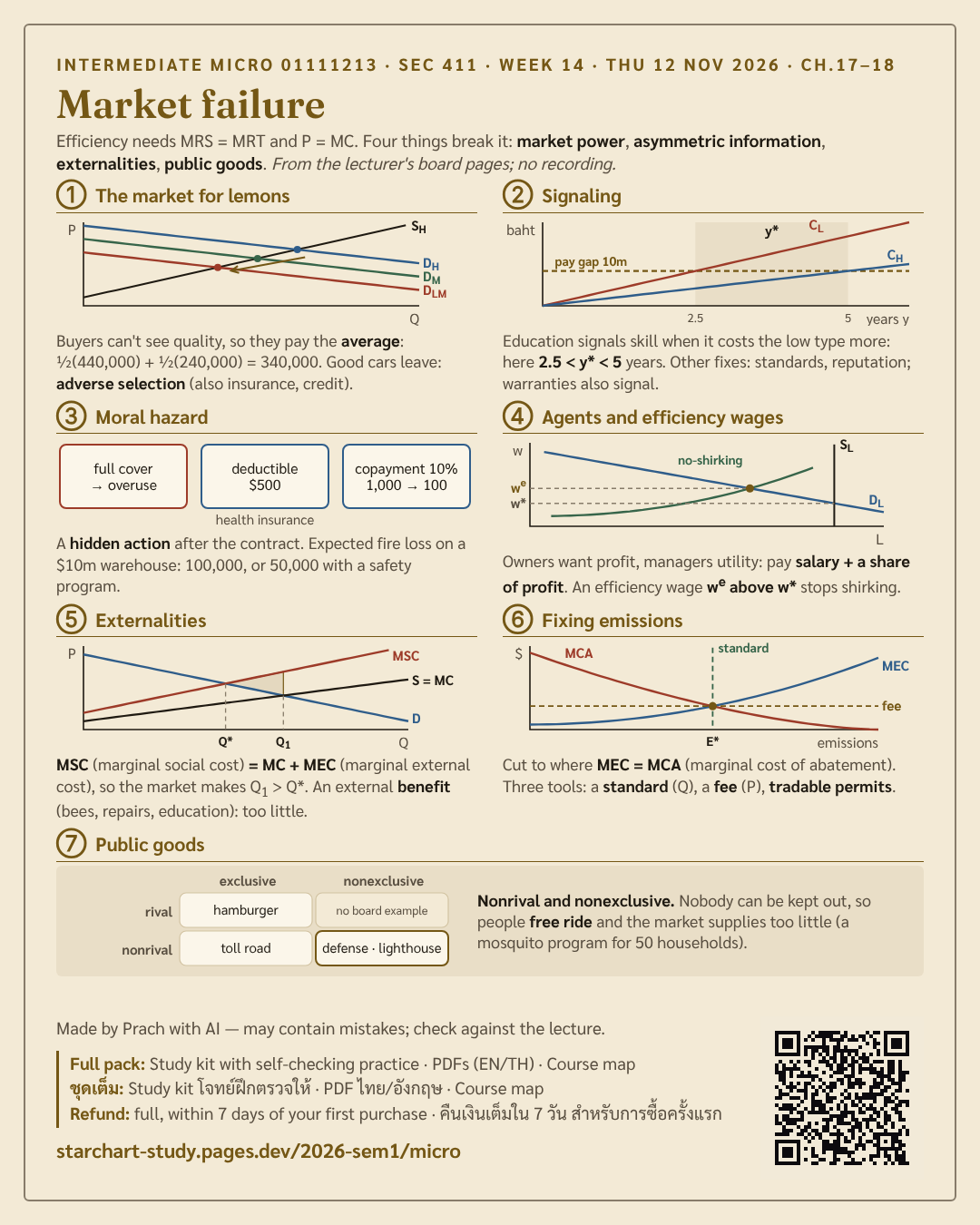 Free · Daily cardฟรี · Daily cardW14 · Ch.17–18 Market failureCh.17–18 Market failureOpenเปิด →
W8 · Monopoly & monopsony5 topics
- MR = MC: the right crossing, and the price it sets
- When demand or cost shifts
- The multiplant firm
- The social cost of monopoly, and regulating it
- Monopsony: the same rule, run by one buyer
W9 · Pricing with market power6 topics
- First degree: each buyer pays the most they would
- Second degree: the more you buy, the less each unit costs
- Third degree: a price for each group
- Two-part tariff: a fee to join, a price to use
- Bundling: sell goods as a package
- Advertising: how much to spend
W10 · Oligopoly5 topics
- Cournot: each firm reacts to the other's output
- Stackelberg: moving first
- Bertrand: competing on price
- Collusion and cartels
- Kinked demand and the dominant firm
W11 · Game theory6 topics
- Dominant strategies
- Iterated elimination: strike out, step by step
- Nash equilibrium: ring the best replies
- Sequential games: solve backward
- Threats, commitment and entry deterrence
- Repeated games: when cooperation holds
W12 · Factor markets6 topics
- Derived demand and the hiring rule
- When capital varies, and the whole industry
- The supply of labor: work against leisure
- Who sets the wage: monopsony, unions, bilateral monopoly
- Land and economic rent
- Capital: PDV, bonds, NPV and IRR
W13 · General equilibrium6 topics
- Partial vs general equilibrium
- Efficiency in exchange: the Edgeworth box
- Efficient is not the same as fair
- Efficiency in production
- Output efficiency: what is made is what is wanted
- Gains from trade: absolute vs comparative advantage
W14 · Market failure6 topics
- Market failure: four causes
- Lemons: adverse selection
- Fixing adverse selection: signaling
- Hidden action: moral hazard
- Externalities: who pays the rest
- Public goods and free riders
See it as a map
W8 · Monopoly & monopsony5 หัวข้อ
- MR = MC: จุดตัดที่ถูก และราคาที่ได้
- เมื่อ demand หรือต้นทุนเปลี่ยน
- Multiplant firm
- Social cost ของ monopoly และการควบคุม
- Monopsony: กฎเดิม ใช้โดยผู้ซื้อรายเดียว
W9 · Pricing with market power6 หัวข้อ
- First degree: ผู้ซื้อแต่ละคนจ่ายเท่าที่ยอมจ่ายสูงสุด
- Second degree: ยิ่งซื้อมาก ราคาต่อหน่วยยิ่งถูก
- Third degree: ราคาสำหรับแต่ละกลุ่ม
- Two-part tariff: ค่าสมาชิก และค่าใช้บริการ
- Bundling: ขายสินค้าเป็นแพ็กเกจ
- Advertising: ควรใช้เงินโฆษณาเท่าไร
W10 · Oligopoly5 หัวข้อ
- Cournot: แต่ละบริษัทตอบสนองต่อผลผลิตของอีกฝ่าย
- Stackelberg: การเดินก่อน
- Bertrand: แข่งกันด้วยราคา
- Collusion และ cartel
- Kinked demand และ dominant firm
W11 · Game theory6 หัวข้อ
- Dominant strategy
- Iterated elimination: ตัดทิ้งทีละขั้น
- Nash equilibrium: วง best reply
- Sequential game: แก้ย้อนกลับ
- Threat, commitment และ entry deterrence
- Repeated game: เมื่อไรความร่วมมือจะอยู่ได้
W12 · Factor markets6 หัวข้อ
- Derived demand และกฎการจ้าง
- เมื่อ capital เปลี่ยนได้ และทั้งอุตสาหกรรม
- Supply of labor: งานกับ leisure
- ใครกำหนดค่าจ้าง: monopsony, union, bilateral monopoly
- ที่ดินและ economic rent
- Capital: PDV, bond, NPV และ IRR
W13 · General equilibrium6 หัวข้อ
- Partial vs general equilibrium
- Efficiency in exchange: Edgeworth box
- Efficient ไม่เท่ากับยุติธรรม
- Efficiency in production
- Output efficiency: ผลิตสิ่งที่คนต้องการ
- Gains from trade: absolute vs comparative advantage
W14 · Market failure6 หัวข้อ
- Market failure: สี่สาเหตุ
- Lemons: adverse selection
- แก้ adverse selection: signaling
- Hidden action: moral hazard
- Externalities: ใครจ่ายส่วนที่เหลือ
- Public goods และ free rider
ดูเป็นแผนที่
Get this passซื้อ pass นี้Sales open soonเปิดขายเร็ว ๆ นี้ →
This week: W14 · Ch.17–18 Market failureสัปดาห์นี้: W14 · Ch.17–18 Market failure
Free · Daily cardฟรี · Daily cardW14 · Ch.17–18 Market failureCh.17–18 Market failureOpenเปิด →Ch2 · S & D6 topics
- The master matrix
- Both curves move
- Movement along vs shift of
- Elasticity changes as you slide down a straight line
- Short run vs long run
- How to do the numbers
Ch3 · Consumer6 topics
- The three assumptions
- Four shapes of indifference curve
- MRS — the slope of the curve
- The budget line
- The two methods for Cobb-Douglas
- When the budget line bends
Ch4 · Demand5 topics
- Splitting the price effect
- How the five bundles relate
- PCC, ICC and the Engel curve
- Marshallian vs Hicksian demand
- Market demand
Ch6 · Production3 topics
- One variable input: TP, AP, MP
- Two variable inputs: isoquants and MRTS
- Returns to scale
Ch7 · Cost4 topics
- Which costs matter
- The seven short-run cost curves
- Choosing inputs to minimize cost
- Long run: scale and scope
Ch8 · Competition6 topics
- Price taker, so MR = P
- The one diagram to be able to draw cold
- Shut down, or carry on at a loss?
- Where is the supply curve?
- Producer surplus is not profit
- Long-run equilibrium
Ch9 · Policy5 topics
- The two surpluses
- Price ceiling
- The other four policies
- Tax: the wedge
- Who bears the tax
W8 · Monopoly & monopsony5 topics
- MR = MC: the right crossing, and the price it sets
- When demand or cost shifts
- The multiplant firm
- The social cost of monopoly, and regulating it
- Monopsony: the same rule, run by one buyer
W9 · Pricing with market power6 topics
- First degree: each buyer pays the most they would
- Second degree: the more you buy, the less each unit costs
- Third degree: a price for each group
- Two-part tariff: a fee to join, a price to use
- Bundling: sell goods as a package
- Advertising: how much to spend
W10 · Oligopoly5 topics
- Cournot: each firm reacts to the other's output
- Stackelberg: moving first
- Bertrand: competing on price
- Collusion and cartels
- Kinked demand and the dominant firm
W11 · Game theory6 topics
- Dominant strategies
- Iterated elimination: strike out, step by step
- Nash equilibrium: ring the best replies
- Sequential games: solve backward
- Threats, commitment and entry deterrence
- Repeated games: when cooperation holds
W12 · Factor markets6 topics
- Derived demand and the hiring rule
- When capital varies, and the whole industry
- The supply of labor: work against leisure
- Who sets the wage: monopsony, unions, bilateral monopoly
- Land and economic rent
- Capital: PDV, bonds, NPV and IRR
W13 · General equilibrium6 topics
- Partial vs general equilibrium
- Efficiency in exchange: the Edgeworth box
- Efficient is not the same as fair
- Efficiency in production
- Output efficiency: what is made is what is wanted
- Gains from trade: absolute vs comparative advantage
W14 · Market failure6 topics
- Market failure: four causes
- Lemons: adverse selection
- Fixing adverse selection: signaling
- Hidden action: moral hazard
- Externalities: who pays the rest
- Public goods and free riders
See it as a map
บท2 · S & D6 หัวข้อ
- ตารางหลัก
- เส้นเคลื่อนทั้งสองเส้น
- เคลื่อนตามเส้น กับ เส้นเลื่อน
- elasticity เปลี่ยนไปตามเส้นตรง
- Short run กับ long run
- วิธีคำนวณ
บท3 · Consumer6 หัวข้อ
- ข้อสมมติสามข้อ
- Indifference curve สี่รูปแบบ
- MRS — ความชันของเส้น
- Budget line
- สองวิธีสำหรับ Cobb-Douglas
- เมื่อ budget line หักมุม
บท4 · Demand5 หัวข้อ
- แยก price effect
- ห้าชุดสัมพันธ์กันอย่างไร
- PCC, ICC และ Engel curve
- Demand: Marshallian กับ Hicksian
- Market demand
บท6 · Production3 หัวข้อ
- ปัจจัยผันแปรหนึ่งตัว: TP, AP, MP
- ปัจจัยผันแปรสองตัว: isoquant และ MRTS
- Returns to scale
บท7 · Cost4 หัวข้อ
- ต้นทุนไหนที่นับ
- Short-run cost curve เจ็ดเส้น
- เลือกปัจจัยให้ต้นทุนต่ำสุด
- Long run: scale และ scope
บท8 · Competition6 หัวข้อ
- Price taker ดังนั้น MR = P
- รูปเดียวที่ต้องวาดได้โดยไม่ต้องคิด
- Shut down หรือขาดทุนต่อ
- Supply curve อยู่ตรงไหน
- Producer surplus ไม่ใช่กำไร
- Long-run equilibrium
บท9 · Policy5 หัวข้อ
- Surplus สองตัว
- Price ceiling
- อีกสี่นโยบาย
- ภาษี: ลิ่ม
- ใครแบกรับภาษี
W8 · Monopoly & monopsony5 หัวข้อ
- MR = MC: จุดตัดที่ถูก และราคาที่ได้
- เมื่อ demand หรือต้นทุนเปลี่ยน
- Multiplant firm
- Social cost ของ monopoly และการควบคุม
- Monopsony: กฎเดิม ใช้โดยผู้ซื้อรายเดียว
W9 · Pricing with market power6 หัวข้อ
- First degree: ผู้ซื้อแต่ละคนจ่ายเท่าที่ยอมจ่ายสูงสุด
- Second degree: ยิ่งซื้อมาก ราคาต่อหน่วยยิ่งถูก
- Third degree: ราคาสำหรับแต่ละกลุ่ม
- Two-part tariff: ค่าสมาชิก และค่าใช้บริการ
- Bundling: ขายสินค้าเป็นแพ็กเกจ
- Advertising: ควรใช้เงินโฆษณาเท่าไร
W10 · Oligopoly5 หัวข้อ
- Cournot: แต่ละบริษัทตอบสนองต่อผลผลิตของอีกฝ่าย
- Stackelberg: การเดินก่อน
- Bertrand: แข่งกันด้วยราคา
- Collusion และ cartel
- Kinked demand และ dominant firm
W11 · Game theory6 หัวข้อ
- Dominant strategy
- Iterated elimination: ตัดทิ้งทีละขั้น
- Nash equilibrium: วง best reply
- Sequential game: แก้ย้อนกลับ
- Threat, commitment และ entry deterrence
- Repeated game: เมื่อไรความร่วมมือจะอยู่ได้
W12 · Factor markets6 หัวข้อ
- Derived demand และกฎการจ้าง
- เมื่อ capital เปลี่ยนได้ และทั้งอุตสาหกรรม
- Supply of labor: งานกับ leisure
- ใครกำหนดค่าจ้าง: monopsony, union, bilateral monopoly
- ที่ดินและ economic rent
- Capital: PDV, bond, NPV และ IRR
W13 · General equilibrium6 หัวข้อ
- Partial vs general equilibrium
- Efficiency in exchange: Edgeworth box
- Efficient ไม่เท่ากับยุติธรรม
- Efficiency in production
- Output efficiency: ผลิตสิ่งที่คนต้องการ
- Gains from trade: absolute vs comparative advantage
W14 · Market failure6 หัวข้อ
- Market failure: สี่สาเหตุ
- Lemons: adverse selection
- แก้ adverse selection: signaling
- Hidden action: moral hazard
- Externalities: ใครจ่ายส่วนที่เหลือ
- Public goods และ free rider
ดูเป็นแผนที่
Get this passซื้อ pass นี้Sales open soonเปิดขายเร็ว ๆ นี้ →
MidtermMidtermWeeks 1–7สัปดาห์ที่ 1–7 · 3 Aug – 18 Sept3 ส.ค. – 18 ก.ย.Free sampleตัวอย่างฟรี
- Study kitStudy kitEvery chapter, computed figures, practice questionsทุกบท กราฟที่คำนวณจริง และโจทย์ฝึกOpenเปิด
- Course mapCourse mapHow the chapters connectแต่ละบทเชื่อมกันอย่างไรOpenเปิด
- Exam packExam pack
- SummarySummaryPDF · 722 KB / 731 KBENTH
- PracticePracticePDF · 518 KB / 538 KBENTH
Free to open, no pass needed. Check everything against the lecture slides.เปิดได้ฟรี ไม่ต้องมี pass ตรวจทุกอย่างกับสไลด์ของอาจารย์อีกครั้ง
Weeks (7)รายสัปดาห์ (7)
- Week 1สัปดาห์ที่ 1The Basics of Supply and Demand (Ch.2)
- Week 2สัปดาห์ที่ 2Consumer Behavior (Ch.3)
- Week 3สัปดาห์ที่ 3Individual and Market Demand (Ch.4)
- Week 4สัปดาห์ที่ 4Production (Ch.6)
- Week 5สัปดาห์ที่ 5The Cost of Production (Ch.7)
- Week 6สัปดาห์ที่ 6Profit Maximization and Competitive Supply (Ch.8)
- Week 7สัปดาห์ที่ 7The Analysis of Competitive Markets (Ch.9)
Final examFinal examWeeks 8–15สัปดาห์ที่ 8–15 · 28 Sept – 29 Nov28 ก.ย. – 29 พ.ย.Needs a passต้องมี passYou have this passคุณมี pass นี้แล้ว
- Study kitStudy kitEvery chapter, with practice questionsทุกบท พร้อมโจทย์ฝึกNeeds a passต้องมี passOpenเปิด
- Course mapCourse mapHow the chapters connectแต่ละบทเชื่อมกันอย่างไรNeeds a passต้องมี passOpenเปิด
- Exam packExam pack
- SummarySummaryPDF · 1.6 MB / 1.7 MBNeeds a passต้องมี passENTH
- PracticePracticePDF · 795 KB / 816 KBNeeds a passต้องมี passENTH
Weeks (8)รายสัปดาห์ (8)
- Week 8สัปดาห์ที่ 8Ch.10 Market power: monopoly and monopsonyCh.10 Market power: monopoly และ monopsonyOpen the Daily cardเปิด Daily cardSummarySummaryENTHPracticePracticeENTH
- Week 9สัปดาห์ที่ 9Ch.11 Pricing with market powerCh.11 Pricing with market powerOpen the Daily cardเปิด Daily cardSummarySummaryENTHPracticePracticeENTH
- Week 10สัปดาห์ที่ 10Ch.12 Monopolistic competition and oligopolyCh.12 Monopolistic competition และ oligopolyOpen the Daily cardเปิด Daily cardSummarySummaryENTHPracticePracticeENTH
- Week 11สัปดาห์ที่ 11Ch.13 Game theory and competitive strategyCh.13 Game theory และ competitive strategyOpen the Daily cardเปิด Daily cardSummarySummaryENTHPracticePracticeENTH
- Week 12สัปดาห์ที่ 12Ch.14–15 Factor marketsCh.14–15 Factor marketsOpen the Daily cardเปิด Daily cardSummarySummaryENTHPracticePracticeENTH
- Week 13สัปดาห์ที่ 13Ch.16 General equilibrium and efficiencyCh.16 General equilibrium and efficiencyOpen the Daily cardเปิด Daily cardSummarySummaryENTHPracticePracticeENTH
- Week 14สัปดาห์ที่ 14Ch.17–18 Market failureCh.17–18 Market failureOpen the Daily cardเปิด Daily cardSummarySummaryENTHPracticePracticeENTH
- Week 15สัปดาห์ที่ 15Market Failure (Ch.17-18) - Last lecture of the semester
Get this passซื้อ pass นี้Sales open soonเปิดขายเร็ว ๆ นี้ →You have this passคุณมี pass นี้แล้ว · My subjectsวิชาของฉัน